If you already have curtains you like, adding a new blind is a nice way to change things up without starting again with the whole window. A blind is a great option for autumn, when you still want to make the most of daylight but need more privacy as the evenings come increasingly earlier.
Of course, the process works in reverse too. A practical but slightly boring blind can stay where it is, with curtains added to soften the window and bring in colour and texture. A heavier curtain fabric can also make the room feel more inviting during the colder months.
Using curtains and blinds together is called layering. It sounds rather more complicated than it needs to be. You just need to decide what you want your blinds and curtains to do, then make sure there is enough room for both at your window.
Table of Contents
Give each layer a purpose
In a living room facing the street, you might want a blind that lets some daylight through while limiting the view inside. Once it gets dark, you can close your curtains for more privacy. Make sure you do your research on the fabric, as not all blinds provide the same amount of privacy.
In a bedroom, a blackout blind could provide the main light control, leaving you free to choose curtains for their colour and feel. Bear in mind that blackout fabric blocks light through the material; light may still enter around the edges, depending on the blind and its fitting. Curtains can help cover some of those gaps, but if you need total darkness, you must plan your arrangement carefully.
You may simply prefer the look of curtains overall, while wanting a light filtering blind to deal with afternoon glare. That is a perfectly good reason to combine them. You do not need to find five benefits to justify a window you enjoy looking at.
Which blinds work well with curtains?
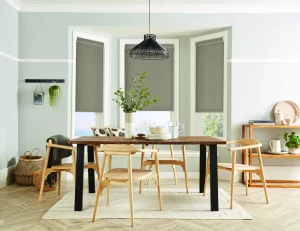
The simple shape of roller blinds leaves plenty of room for your curtain fabric to take centre stage. A plain roller blind can sit comfortably behind a patterned pair of curtains, while a light-filtering fabric lets you soften daylight without drawing the curtains across the window. A translucent blind, a dim-out blind and a blackout roller blind will give you different results, so we recommend choosing fabrics according to their function rather than colour alone.
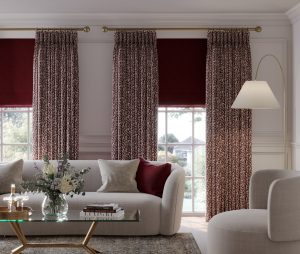
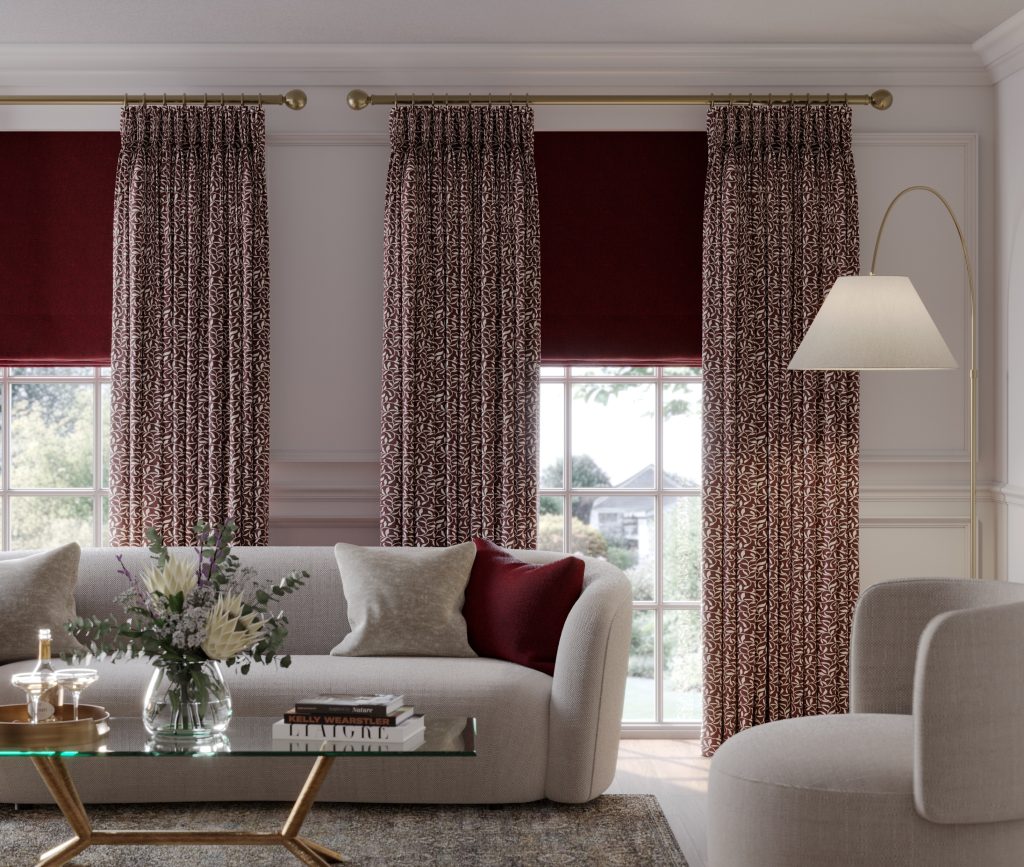
Roman blinds with curtains create a fuller fabric arrangement. This can suit a living room or bedroom where you want a soft or classic finish, but it needs a little more thought. A raised Roman blind forms a stack of folds at the top of the window. Its position affects how much glass remains clear, and the curtain fittings need enough space around it. If you like this combination, consider a patterned Roman blind with plain curtains, or two fabrics linked by a colour. They can belong together without being identical, especially in rooms with bold or maximalist interior décor. However, arrangements like these may be better suited to rooms with windows on the larger side. A small window may get swamped by all the fabric.
Shutters and curtains also make a good pairing. The shutters let you adjust the louvres for light and privacy, while the curtains add softness around the window. Check the opening movement before choosing the track or pole: the shutter panels need a clear & uninterrupted path, and the curtains should be able to draw back far enough to allow access to the shutters.
Choose fabrics that get along
There is no rule that your blind and curtains must match exactly. In fact, choosing slightly different textures can make the combination more interesting.
If you have patterned curtains, pick out one of their quieter colours for a plain blind. That gives the fabrics a connection without making the design look repetitive or overwhelming. You could also keep both neutral and use texture for variety, particularly if the room already has patterned wallpaper or furniture.
Look at samples together, rather than choosing each fabric separately and hoping for the best. Two whites can be surprisingly argumentative when one is warm and the other has a cooler tone.
While comparing samples, make sure you take your furniture into account too. A new window arrangement should sit comfortably with your sofa and flooring. You should not have to replace half the room because new curtains have arrived.
Does layering blinds and curtains help in cold weather?
Thick curtains or curtains with a thermal lining can help reduce heat loss through windows when closed. The Energy Saving Trust recommends closing them at night and keeping them clear of radiators so heat can circulate into the room.
Adding a blind gives you another way to manage the window, but the thermal benefit depends on its design, fabric and fit. A thin, sheer roller blind cannot be expected to provide the same insulation as a cellular blind designed for that purpose.
If warmth is a priority, tell us before choosing the fabrics. We can discuss suitable blinds and curtain linings alongside the appearance you want.
There is also a practical point to consider with curtain length. Floor-length curtains may look lovely, but if a radiator sits beneath the window, covering it with closed curtains can trap its heat behind the fabric and you won’t feel the benefit.
Leave room for everything to move
It’s not as exciting to think about, but the fitting deserves as much attention as the fabrics. A blind inside the window recess with curtains outside it is a common arrangement, although the recess must be suitable. We need to consider its depth, projecting handles and how the window opens.
The curtain track or pole should position the fabric far enough forward to clear the blind. There also needs to be space at the sides for the curtains to gather when open. On a smaller window, a bulky pair of curtains can cover quite a lot of glass even when you have drawn them back. Remember the controls too. You should be able to adjust the blind without reaching awkwardly behind the curtain fabric.
These details are easier to resolve before either product is ordered. If you are keeping existing curtains or blinds, we can assess the new addition around them.
Bringing blinds and curtains together
We supply made-to-measure curtains and blinds in West Sussex, along with tracks and poles, and can help you plan the combination from fabric choice through to fitting.
Bring photographs of your window and any fabrics you want to keep. We can talk through how you use the room and compare suitable options. When we come to measure up during your home consultation, we’ll check that there is enough space for both layers.
Book a home consultation or visit our showroom to explore curtains and blinds together.